Tag: praise

  • Who’s in Charge?

    Who’s in Charge?

    Inspired by Guadalupe River State Park

    I’m the type who likes to make plans. I love to make bucket lists for each season and to-do lists for each day. I love doing projects and watching the development from start to finish. I love planning vacations and family visits. I even plan time for planning.

    My brother has explained to me that I compensate for anxiety by making plans. This compensatory skill has become especially helpful in dealing with chaotic and difficult seasons, as well as the unpredictability of parenting.

    While on my personal path of looking ahead and making plans, I’ve been picking and choosing what I want to hear from God, the Lord of hope. I’ve been reading scripture that promises that good is triumphant over evil, that we have hope as an anchor, and that the Lord can overcome all struggles. I like scripture that coincides with my plans.

    Then, I came across the type of story I was trying to avoid in Jeremiah 27-29. 

    Jeremiah prophesied that the Israelites would serve under King Nebuchadnezzer of Babylon, his son, and his grandson. They would leave their homeland and submit to the control of a king they distrusted. The Israelites didn’t like this prophesy. Many didn’t want to believe that they would give up freedoms and even die far from home while under King Nebuchadnezzer’s rule. They were told it would be 70 years of oppression. 70 years away from the comfort of home. 70 years living a life they had not planned.

    This opened the door to a false prophet, Hananiah, who promised that the people would return to their land and the lives they were used to within two years. It was a promise people could cling to. Hananiah’s prophecy offered hope. The Israelites could make their plans. 

    But Hananiah was wrong. The Israelites were exiled. Their plans were destroyed… their hope, diminished.

    If I lived during the 6th century, BC, who would I have chosen to believe – Jeremiah or Hananiah?

    I probably would have listened to the false prophet. His promise would’ve matched my plans. His prophecy would’ve sounded better for my idea of the life I desire for myself and my family. It would’ve offered my version of hope, just as I choose to believe that this political season and economic downturn, full of anger, division, frustration, decline, and violence, will end soon and lead to significant change in our nation. I’m making my plans! 

    However, it’s not about me and my plans. The hope our Father offers is not related to the leader of this nation or how much money we can save (or spend). I have to remember the true message in Jeremiah’s prophecy.

    Jeremiah encouraged the Israelites to live well while in exile, even if their own plans for a good life would never come to fruition. They were called to worship the true king, work hard even under oppressive rule, to sow gardens they may never get to reap, to build homes somewhere other than their homeland, to marry despite their inward strife, to have children potentially bound to slavery, and to pray for the town and the king they did not choose.

    In Jeremiah 29:11, he adds God’s familiar promise: “For I know the plans I have for you. They are plans for good and not for disaster, to give you a future and a hope.” 

    This bit of scripture reminds us that we have many blessings and opportunities to live a fruitful life no matter the circumstances we find ourselves in. Our idea of abundance may not match His, but God is good in all situations, seasons, and political regimes, even if His own plans don’t make sense to me or align with mine.

    There is always a greater promise than the earthly plans we make for ourselves, and it will be better than we could have ever imagined. I will worship the king of kings above all else and rely on the hope He promises, regardless of current circumstances and my own faltered plans.

    This piece is inspired by Guadalupe River State Park. We love visiting this park because of the beautiful river running through it, the kid-friendly trails, the discovery room, and the stunning views. Although the river is fun to swim in and quite calm near the banks, the current can surprise you and take control.

    Once, when my husband and I brought our two toddlers to the park, we waded out to the center of the shallow river, each holding one of our little ones , who wore puddle jumper floaties because they were not yet swimmers. As we ventured toward the small ripples in the water, something took hold of us, and we were no longer in control.

    The current slammed our bodies into large rocks underwater, and there was no way to get our footing. We struggled to keep our babies, and even our own heads, above water. As I recognized that we weren’t able to keep our kids and ourselves safe, I screamed, “toss the babies to shore”. With as much might as we could muster, we launched the kids out of the current’s path and prayed they could stand and get to shore. We had to let go and trust that they would be ok.

    Then, we could use our freed hands to swim toward the shore ourselves. It worked, and the kids were safe! Thank God we walked away with just cuts and bruises, as well as a greater appreciation for the forces of nature.

  • Simple, Not Easy

    Simple, Not Easy

    Inspired by Peaceful Porches

    So many goals in life are simple to achieve. Connection with family members grows with uninterrupted time together. Wealth comes with spending less and investing the remainder. Weight loss requires eating clean and exercising daily. The instructions seem so basic and simple. However, they are rarely easy.

    The instruction I especially find to be simple but not easy is the call for us to live as Jesus did. His life was busy and full, yet he was never hurried and definitely lived simply.

    It is no longer I who live, but Christ who lives in me. And the life I now live in the flesh I live by faith in the Son of God, who loved me and gave himself for me.

    Galatians 2:20

    We are instructed to place all trust in Him and live by faith. We are given stories of the life we’re meant to emulate, the life of Jesus.

    I have short, simple phrases on a chalkboard hanging next to our dining table to describe the way Jesus lived as a guide for my family. This is a rudimentary interpretation of how to walk through life like Jesus did:

    Go for a long walk. Simple. Love others. Simple. Ask questions and listen for the answers. Simple. Invite others in for a meal or a chat. Simple. Find solitude and rest. Simple.

    If the principles are simple, why is it so difficult to implement them?

    We are human. We’re sinners. We’re easily distracted and easily charmed by the ways of this world. We enjoy material possessions. We can be manipulated by marketing and advertising. We like to be entertained, even by immoral people and practices. We are stubborn and headstrong. We think we know better about how to live a full life.

    Our lives are certainly full. My life, in particular, is full of responding to kids’ needs, cooking, cleaning, gardening, soccer practices and games, errands, calendar planning, homeschooling, friends and social activities, travel, budgeting, investing, reading, writing, and so much more. I’m sure your list is just as long too. We have busy lives, affording little time left over to focus on how to yield to the Holy Spirit and live as Jesus taught us.

    The good news is that it’s possible to have both. We just have to prioritize the simple. We have to redeem our time in order to live like our Redeemer. In Jordan Raynor’s book, Redeeming Our Time, the author lays out 7 principles for living a more purposeful, productive, and present life that would emulate the life of Jesus much more closely than how most of us live today. The 7 principles are:

    • Start with the Word
    • Let your Yes be Yes
    • Dissent from the Kingdom of Noise
    • Prioritize your Yeses
    • Accept your Unipresence
    • Embrace Productive Rest
    • Eliminate All Hurry

    I recommend checking out his book and/or his week-long devotional through the Bible app. It’s a great way to get started on living more simply yet remaining focused on the gifts and purpose the Lord has set for your life.

    I’d also recommend finding a place that allows you to separate from the noise of this world, rest and renew yourself, and pray without distraction. Until we intentionally center our lives around the simple, we will continue to let the frenzy of this world lead us away from our purpose. I’m most certainly aware, though, that this is much easier said than done.

    When I need to find solitude and a little quiet time to focus, I love stepping out onto my back porch or the porch of any home we stay in while traveling. Although I can hear the sounds of birds, cicadas, cars, and children playing in back yards, I feel a sense of peace as soon as I shut the door and breathe in the fresh air. It’s often where I read, pray, write, and do yoga. That place of solitude is different for each person and at each home, but it’s so essential for embracing the simple side of life. I hope you’ve found yours.

    Hyatt Hill Country in San Antonio, TX
    Washington on the Brazos State Historic Site
    The Kendall in Boerne, TX
  • Small Minds Discuss People

    Small Minds Discuss People

    Inspired by the LBJ Ranch and National Historical Park in Stonewall, TX

    I wrote much of the piece below 4 years ago. Now in 2024, we find ourselves caught in another election season, and it seems not much has changed. In fact, the divisiveness and anger may have heightened since 2020.

    My older two children are 13 and 10, one in 8th grade and the other in 5th. At our dinner table, there is often an accusation of a crush, followed by “no way” and reasons why that person would never be the object of my child’s affection. Other times, I hear comments about something ridiculous a classmate did or said at school, accompanied by giggles, or I witness my precious children mocking one another.

    My kids love to talk about people but not always in a kind way, and no matter how often we adults in the room try to steer the discussion toward big ideas, plans, or life lessons, the conversation reverts back to the gossip du jour or mere mockery.

    The discussions held during election season aren’t much better than the childish banter at my dinner table, except that the adults are the ones engaging, rather than stifling, the rude repartee. When I read comments online, listen to a debate on a podcast, or hear the talking points on the news, the issues examined are rarely policy initiatives but rather personal insults about candidates. It seems that we have become a nation that talks about people, often in an unkind way, rather than one that shares ideas and implements them for the good of our country.

    Eleanor Roosevelt once said, “Great minds discuss ideas; average minds discuss events; small minds discuss people.”

    Based on what’s portrayed on the internet and TV, we are a nation of small minds. It’s as if we’ve lost sight of who God created us to be. We are here to build His kingdom, to share the good news, to live by the fruit of the Spirit, and to love first. These are not expectations that can be held for all people, but it’s a standard I would like to uphold for myself, my family, and those who step up to lead communities and a nation.

    This is no easy feat. Passing judgment is a common human trait, and gossip flows easily from most mouths. Angry or hateful messages are rewarded with engagement, clicks, and likes. Emotions are held in higher regard than logical thinking, and strong opinions are more interesting than facts. The nature of our society can be ugly and unkind, focused heavily on how other people behave.

    So, how do we change course? How do we choose a different path than the masses who have infiltrated social media, the city’s streets, and news outlets with angry words about people who are also loved by God?

    Fortunately, I know a place where I can look for answers. Ephesians 4:29 (NIV) provides us with this lesson:

    Do not let any unwholesome talk come out of your mouths, but only what is helpful for building others up according to their needs, that it may benefit those who listen.

    This verse is often repeated and now written in many places in our house. We remind our children of this instruction often when the dinner table discussion veers off course. My prayer for myself, my children, and our nation is that we can use our words to build others up, share ideas, and respect each other, rather than continue to tear down the nation and the people our Father created. Maybe if each of us holds Ephesians 4:29 close to our hearts and draws it from memory on a daily basis, our next election season can reflect the great minds the Lord gave us.

    This week’s devotional is inspired by the LBJ Ranch, Texas White House, and LBJ Airport in Stonewall. They are part of a driving tour, which includes a few stops to visit actual sites where President Johnson and other members of government, including President Truman, met to discuss the future of our nation. Many people have strong opinions about LBJ’s presidency, and while I accept and understand those points of view, I think more about the ideas that were discussed and the reasons behind them. I imagine the critical debates held after our nation was rocked by an assassination that left many Americans grieving and sharing theories (for decades) about what happened. I wonder what the chats were like on the porches and behind closed doors at the Texas White House and in what manner they spoke to each other. I also think about how far we’ve strayed from the intent of our founding fathers and whether we’ve ever *truly* been one nation under God, indivisible, with liberty and justice for all. Can we ever return to civil political discourse and move away from the online forums with angry, anonymous, amateur analysts? Looking back may be our only way to look forward.

  • The Benefits of Thanksgiving

    The Benefits of Thanksgiving

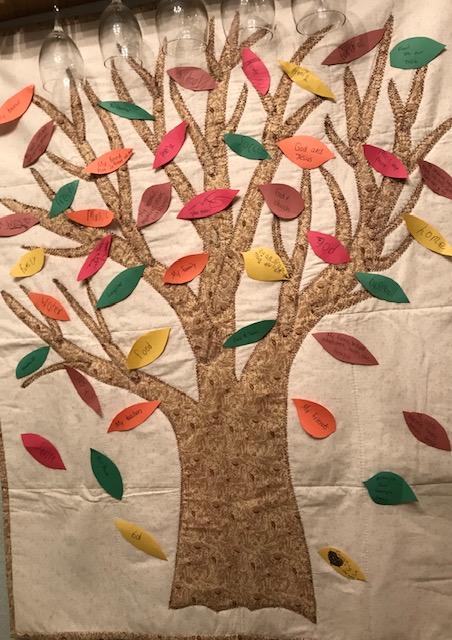
    I love that many families practice gratitude for the entire month leading up to Thanksgiving. The tradition of a Thankful Tree is one of my family’s favorites, and I’m pleasantly surprised that it’s something our children look forward to as well.

    Thankful tree

    On the first of November when the sugar rush from Halloween is starting to subside, we display the hand-sewn wall hanging my mother-in-law made, and I unevenly cut leaf shapes out of six fall shades of construction paper. Each family member gets his or her own color, and at dinner throughout the month, we write something we are thankful for on our leaves. It can be big and abstract, like love or faith, or it can be something as small and simple as pencils and paper, which was displayed on one of my preschooler’s leaves last Fall. (If you’ve been wanting to start this tradition but don’t want to make one yourself, Amazon has a great option.)

    After the Thanksgiving holiday, I save those little leaves of gratitude in our family time capsules to look back on in the future. In addition to the answers that make me a proud mama, such as Jesus, family, veterans, teachers, and neighbors, so many of my kids’ and husband’s answers reveal quite a bit about their current personalities and interests. A few that my mom-brain has allowed to seep into long-term memory include:

    • “Johnny Football” – my rebellious daughter’s answer when the Aggie quarterback was blowing up the college football scene, despite her mother’s affiliation to the Texas Longhorns
    • “Hot lunches” – my husband’s not-so-discrete way to show his gratitude for mid-day *alone time* with me
    • “Paw Patrol waffles” – just one of the specific food answers given by the toddlers in our home
    • “My future dog” – yet another clever opportunity for my kids to beg for a pet

    I absolutely love hearing and reading what each of my family members is thankful for, and there are no rules about what to say or write, just that you have to come up with something. But more importantly, I love that we’re taking even just a couple minutes out of our day to focus on gratitude. I cherish those moments that can quickly reverse the criticism, complaining, and chaos that often manifests during our busy afternoons.

    There has been quite a bit of research done across multiple disciplines about the benefits of gratitude, from the religious sectors all the way to the personal finance industry. Gratitude simply makes life better. It has been shown to improve your mental, physical, and emotional health. It opens the door to better relationships, both personal and spiritual. It enhances empathy and leads to less aggression and more acceptance. Also, grateful people sleep better, eat healthier, and build stronger careers. Grateful people even spend less money!

    So, why do so many of us intentionally practice giving thanks ONLY in the month of November? This practice needs to be a year-round aspiration! When that Thankful Tree is soon replaced by another holiday tree, then Valentine’s hearts, then Easter baskets and Spring flowers, what gratitude tradition will carry on? Here are a few (maybe less-obvious) ways to sustain the benefits of Thanksgiving throughout the year…

    Praise and Prayer

    Hang a poster board, butcher paper, or a chalk board up with the words, “Praise” and “Prayer”, in a high traffic area in your home, such as the back door or the mud room. Encourage family members to write what they are thankful for on the Praise side and ask for prayers for themselves and others on the opposite side.

    gratitude journal

    Gratitude Journal

    Keep a spiral notebook open on the kitchen counter and have each person jot down something they are grateful for or something they’re looking forward to in the journal each day. Bring it to the dinner table one day per week and share your family’s good news with each other.

    Random Thank You Notes

    random thank you notes to instill gratitude

    I am terrible at writing out thank you notes after a birthday party. I wish I was better at it, but maybe thank you notes would be even more appreciated when they’re not considered obligatory. Keep thank you notes available in your home and practice writing notes to friends after an act of kindness or a fun night out. Encourage your kids to do the same, even to their own siblings. Gasp! 

    Closet and Pantry Inventory

    Before going shopping for something new or for Christmas gifts, take a mental (or written) inventory of what’s in your closet or pantry. This can help you and your kids recognize how much you already own and be grateful for it. This practice will also likely prevent you from over-spending on what you don’t really need. Also, you may even find gifts for others in your home and skip the shopping trip altogether.

    Pick a “No-Negativity Day”

    Life is tough! Venting helps.

    But maybe, just one day per week can become a sacred “No-Negativity” day. On this day, focus entirely on being positive. This would be a HUGE challenge for me and therefore, this is one tradition I’m going to strive for throughout the year! Someone please hold me accountable.

    For where your treasure is, there your heart will be also.

    Matthew 6:21

    In this season of thankfulness, I am truly grateful that I have the freedom to try something fun and to venture out of my comfort zone by writing and sharing my random thoughts in this blog, but I am even more thankful for those of you who take the time to read it.

    Find more Dripping with Kids at https://www.instagram.com/dripping_with_kids/ or on Facebook at https://m.facebook.com/drippingwithkidsblog/.

  • The Benefits of Thanksgiving

    The Benefits of Thanksgiving

    I love that many families practice gratitude long before the actual day of Thanksgiving, and the tradition of a Thankful Tree is one of my favorite family traditions. I’m pleasantly surprised that it’s something our children look forward to as well. On the first

    Thankful tree

    of November when the sugar rush from Halloween is starting to subside, we display the hand-sewn wall hanging my mother-in-law made, and I unevenly cut shapes slightly resembling leaves out of six fall shades of construction paper. Each family member gets his or her own color, and at dinner throughout the month, we write something we are thankful for on our leaves. It can be big and abstract, like love or faith, or it can be something as small and simple as pencils and paper, which was displayed on one of my preschooler’s leaves last Fall. After the month of Thanksgiving ends, I save those little leaves of gratitude in our family time capsules to look back on in the future. In addition to the answers that make me a proud mama, such as Jesus, family, veterans, teachers, and neighbors, so many of my kids’ and husband’s answers reveal quite a bit about their current personalities and interests. A few that my mom-brain has allowed to seep into long-term memory include:

    • “Johnny Football” – my rebellious daughter’s answer when the Aggie quarterback was blowing up the college football scene, despite her mother’s affiliation to the Texas Longhorns
    • “Hot lunches” – my husband’s not-so-discrete way to show his gratitude for mid-day *alone time* with me
    • “Paw Patrol waffles” – just one of the specific food answers given by the toddlers in our home
    • “My future dog” – yet another clever opportunity for my kids to beg for a pet

    I absolutely love hearing and reading what each of my family members is thankful for, and there are no rules about what to say or write, just that you have to come up with something. But more importantly, I love that we’re taking even just a couple minutes out of our day to focus on gratitude. I cherish those moments that can quickly reverse the criticism, complaining, and chaos that often manifests during our busy afternoons.

    Thankful

    There has been quite a bit of research done across multiple disciplines about the benefits of gratitude, from the religious sectors all the way to the personal finance industry. Gratitude simply makes life better. It has been shown to improve your mental, physical, and emotional health. It opens the door to better relationships, both personal and spiritual. It enhances empathy and leads to less aggression and more acceptance. Also, grateful people sleep better, eat healthier, and build stronger careers. Grateful people even spend less money!

    So, why do so many of us intentionally practice giving thanks ONLY in the month of November? This practice needs to be a year-round aspiration! When that Thankful Tree is soon replaced by another holiday tree, then Valentine’s hearts, then Easter baskets and Spring flowers, what gratitude tradition will carry on? Here are a few (maybe less-obvious) ways to sustain the benefits of Thanksgiving throughout the year…

    1. Praise and Prayer Board – Hang a poster board, butcher paper, or a chalk board up
      Praise and Prayer
      with the words, “Praise” and “Prayer”, in a high traffic area in your home, such as the back door or the mud room. Encourage family members to write what they are thankful for on the Praise side and ask for prayers for themselves and others on the opposite side.
    2. Gratitude Journal – Keep a spiral notebook open on the kitchen counter and have each person jot down something they are grateful for or something they’re looking forward to in the journal each day. Bring it to the dinner table one day per week and share your family’s good news with each other.
    3. Random Thank You Notes – I am terrible at writing out thank you notes after a
      thank you
      birthday party. I wish I was better at it, but maybe thank you notes would be even more appreciated when they’re not considered obligatory. Keep blank thank you notes available in your home and practice writing notes to friends after an act of kindness or a fun night out. Encourage your kids to do the same, even to their own siblings. Gasp!
    4. Closet and Pantry Inventory – Before going shopping for something new, take a mental (or written) inventory of what’s in your closet or pantry. This can help you or your kids recognize how much you already own and be grateful for it. This practice will also likely prevent you from over-spending on what you don’t really need.
    5. Pick a “No-Negativity Day” – Life is tough! And venting helps! But maybe just one day per week (or month) can become a sacred “No-Negativity” day. On this day, focus entirely on being positive. This would be a HUGE challenge for me and therefore, this is one tradition I’m going to strive for throughout the year! Someone please hold me accountable.

    In this season of thankfulness, I am truly grateful that I have the freedom to try something fun and to venture out of my comfort zone by writing and sharing my random thoughts in this blog, but I am even more thankful for those of you who actually take the time to read it. Thank you!

    Find more Dripping with Kids at https://www.instagram.com/dripping_with_kids/ or on Facebook at https://m.facebook.com/drippingwithkidsblog/.